EN
EN

Unmatched Precision for Tight-Tolerance Metal Cutting
How Blade Geometry, Tension Control, and CNC Feed Rate Deliver Sub-Millimeter Accuracy on Steel and Aluminum
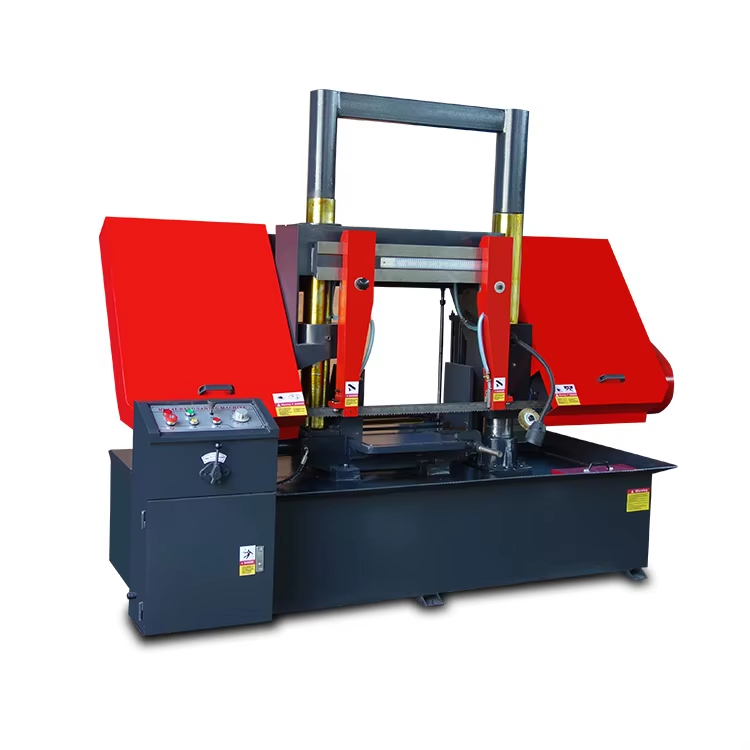
Achieving dimensional accuracy below 0.1 mm in metal band sawing demands tightly integrated engineering—not just isolated features. Optimized blade geometry—particularly tooth pitch and gullet design—minimizes vibration and ensures stable, continuous contact with the workpiece, directly supporting sub-millimeter repeatability. Hydraulic tension control maintains blade tautness within ±2% variance, eliminating deflection-induced drift—especially critical when cutting structural steel sections prone to torsional flex. Meanwhile, CNC feed systems dynamically adjust cutting pressure in real time based on material density and hardness, enabling consistent performance across alloys from soft aluminum to hard titanium. Together, these technologies deliver verified ±0.05 mm tolerances across production runs, confirmed by laser metrology. Unlike abrasive methods, this integrated approach sustains precision without widening kerf or inducing thermal distortion—preserving 15–18% more usable material from high-value stock. Industry benchmarks show aerospace manufacturers achieve first-pass success rates above 98% on critical components when all three systems operate in concert.
Significant Efficiency Gains with Metal Band Sawing Machine
40–60% Faster Cycle Times vs. Cold Saws and Abrasive Cut-Off Machines
Metal band sawing machines outperform cold saws and abrasive cut-off systems primarily through uninterrupted cutting action. Rotational repositioning (cold saws) and heat-limited dwell cycles (abrasive wheels) introduce non-productive intervals; band saws maintain constant tooth engagement, slashing cycle times by 40–60% on structural steel and aluminum profiles. This advantage is amplified by intelligent chip load management: continuous, evenly distributed tooth engagement prevents localized work hardening while evacuating swarf efficiently—even at sustained bi-metal blade speeds of 300+ SFM. Real-world fabrication data shows throughput rising from ~30 I-beams/hour on cold saws to over 50/hour on advanced band saws—a productivity gain that translates to $740k in annual operational savings on high-volume runs, per Ponemon Institute’s 2023 Fabrication Benchmark Report.
Reduced Downtime via Variable Speed Control and Intelligent Automatic Shut-Off
Variable speed control significantly curbs unplanned stoppages by adapting blade velocity and feed pressure to real-time material conditions. When encountering hardened zones or alloy transitions, the system modulates feed force while preserving tooth engagement—avoiding the tooth stripping that triggers 15-minute blade changeovers. Integrated sensors monitor three key failure precursors: blade deflection beyond 0.5 mm, hydraulic pressure drops below operational thresholds, and motor temperature exceeding 65°C. Upon detection, the machine initiates immediate shut-off—preventing catastrophic damage and reducing repair-related downtime by 70%. Coolant flow monitoring further extends blade life up to 30% versus fixed-speed systems. As a result, monthly maintenance windows shrink from 8 hours to under 90 minutes—maximizing equipment uptime and utilization.
Broad Material and Shape Versatility of the Metal Band Sawing Machine
Seamless Cutting of Solid Bars, Hollow Pipes, and Structural Steel Sections in One Setup
Metal band sawing machines unify what legacy systems treat as separate operations: solid bar stock, thin-walled hollow pipes, and complex structural sections like I-beams and channels—all cut reliably in a single setup. This versatility stems from adaptive blade guidance, tunable tension systems, and profile-aware feed algorithms—not interchangeable tooling. Leading OEMs calibrate tooth geometry and tension response to sustain optimal 80–250 SFM cutting speeds across ferrous and non-ferrous alloys without sacrificing surface integrity or dimensional stability. The result? A 70% reduction in changeover time compared to dedicated cut-off solutions. Crucially, the ultra-narrow kerf—as low as 0.8 mm—minimizes heat input and preserves material yield, particularly vital for high-value alloys. According to the 2024 Industrial Sawing Report, this capability delivers 18–22% material savings over abrasive alternatives, while automated feed systems ensure consistency even on irregular or asymmetric profiles.
Optimized Material Utilization and Cost Savings
Ultra-Narrow Kerf (as Low as 0.8 mm) Maximizes Yield in High-Value Alloys Like Titanium and Inconel
The metal band sawing machine’s defining efficiency advantage lies in its ultra-narrow kerf—down to 0.8 mm—enabled by precision blade guidance, optimized tooth geometry, and stable tension control. This minimal material removal is transformative for expensive alloys: titanium ($150/kg) and Inconel ($120/kg), where every millimeter saved compounds rapidly across volume. Compared to conventional abrasive or reciprocating methods, the narrow kerf recovers up to 15% more usable material per workpiece—directly lowering raw material spend and scrap disposal costs. Critically, kerf consistency is maintained across complex geometries—whether slicing thick-walled structural beams or thin-walled tubing—thanks to closed-loop blade tracking and adaptive feed compensation. These gains scale linearly in high-volume production, making the metal band sawing machine not just a cutting tool, but a strategic asset for cost-driven, precision-focused manufacturing.
FAQ
What is the main advantage of using a metal band sawing machine?
The primary advantage is achieving unmatched precision with tight tolerances, delivering sub-millimeter accuracy, increased efficiency, and significant material savings especially in high-value alloys.
How do metal band sawing machines reduce cycle times compared to other sawing methods?
Metal band sawing machines maintain constant tooth engagement, unlike cold saws and abrasive machines that introduce non-productive intervals, reducing cycle times by 40-60%.
Can metal band saws handle different materials and shapes?
Yes, metal band saws can seamlessly cut solid bars, hollow pipes, and structural steel sections without the need for changeovers, making them very versatile.
What role does blade tension play in precision cutting?
Hydraulic tension control maintains blade tautness, preventing deflection-induced drift, which is critical for precision cutting of structural steel sections.
How does the ultra-narrow kerf contribute to cost savings?
The ultra-narrow kerf maximizes material yield, especially in expensive alloys, leading to up to 15% more usable material per workpiece. This directly reduces raw material costs and waste.
Table of Contents
- Unmatched Precision for Tight-Tolerance Metal Cutting
- Significant Efficiency Gains with Metal Band Sawing Machine
- Broad Material and Shape Versatility of the Metal Band Sawing Machine
- Optimized Material Utilization and Cost Savings
-
FAQ
- What is the main advantage of using a metal band sawing machine?
- How do metal band sawing machines reduce cycle times compared to other sawing methods?
- Can metal band saws handle different materials and shapes?
- What role does blade tension play in precision cutting?
- How does the ultra-narrow kerf contribute to cost savings?