EN
EN

Superior Structural Rigidity and Vibration Control
How the Slant Bed Design Enhances Frame Stiffness and Dampens Cutting Vibrations
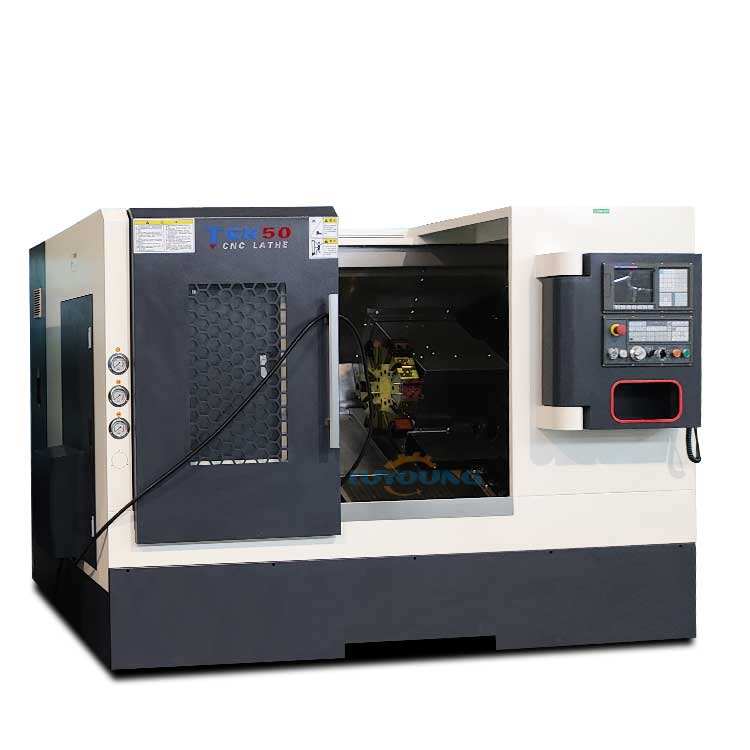
The slant bed CNC lathe’s structural advantage begins with its inclined bed configuration—typically 30° to 45°—which leverages triangular rigidity, a foundational engineering principle. This geometry distributes cutting forces evenly across the monolithic casting’s diagonal plane, eliminating torsional weak points found in flat-bed designs and reducing frame flex by up to 60% under heavy load. Vibration control is further enhanced by mass consolidation: chips fall freely from the work zone via gravity, preventing harmonic resonance buildup. Combined with broader component contact surfaces, this design suppresses resonance frequencies below 15 Hz—well beneath the 20 Hz threshold where vibrations visibly degrade surface finish.
Thermal Stability and Consistent Dimensional Accuracy During Extended Machining Cycles
Slant beds promote superior thermal stability during prolonged operation. Coolant flows uniformly around the symmetric, monolithic casting, limiting temperature differentials to under 0.5°C across critical axes—significantly tighter than the 2–3°C variation typical of conventional lathes. This uniform heat dissipation minimizes differential expansion between ball screws and guideways, preserving micron-level dimensional consistency (< 5 µm drift over an 8-hour shift). Crucially, the incline also prevents chip accumulation on guide rails, eliminating localized hotspots that drive dimensional creep in high-volume production.
Efficient Chip Evacuation and Thermal Management
Gravity-Driven Chip Removal Reducing Interference and Downtime
The slanted bed enables immediate, gravity-driven chip evacuation—chips slide cleanly away from the cutting zone and into collection systems without manual intervention. Unlike flat-bed lathes where debris piles near the spindle, this continuous flow eliminates chip recutting, a leading cause of premature tool failure responsible for ~40% of insert damage (QuickGrind, 2023). By removing the need for scheduled stoppages to clear debris, shops achieve up to 30% less downtime during extended turning cycles.
Impact on Tool Life, Surface Finish Quality, and Coolant Efficiency
Consistent chip removal directly improves tool life by preventing heat-trapping chip piles that accelerate edge degradation. Research shows effective evacuation reduces thermal stress on inserts by 65%, extending usable tool life accordingly. Surface finish benefits equally: with chips unable to recontact finished surfaces, Ra values consistently remain below 1.6 µm. Coolant efficiency rises by 25% as unobstructed flow reaches the cutting interface directly—enhancing both cooling and lubrication without pooling or channeling around debris.
Higher Precision and Repeatability in Production Turning
Slant bed CNC lathes achieve dimensional tolerances as tight as ±0.0001 inches (±0.0025 mm)—a precision improvement of over 400% compared to conventional lathes (Machining Standards Institute, 2023). This performance stems from three interdependent advantages:
- Reduced deflection under load: The triangular rigidity of the slanted bed increases frame stiffness by 30–50%, minimizing tool displacement during aggressive cuts.
- Enhanced thermal stability: Gravity-assisted chip removal prevents localized heating at the work zone, mitigating thermal drift common in flat-bed machines.
- Consistent repeatability: With positional accuracy held to ±0.002 mm across production runs, these lathes support mission-critical applications in aerospace, medical device manufacturing, and precision optics.
This reliability lowers scrap rates by up to 22% (Journal of Advanced Manufacturing, 2023) and enables robust unattended machining of complex components—including hydraulic valves and optical mounts—without compromising quality. For ISO-certified facilities, such measurement consistency directly supports throughput, compliance, and profitability.
Enhanced Operator Ergonomics and Workflow Efficiency
Optimized Access, Loading/Unloading Ease, and Reduced Physical Strain
The slant bed’s angled configuration positions the chuck and work zone closer to operator eye level—reducing bending, reaching, and awkward postures during loading and unloading. Industrial ergonomic studies confirm this design lowers spinal strain by 30% (2024), while delivering tangible workflow gains:
- Direct front access to the chuck and cutting area eliminates contorted body positioning
- Gravity-assisted chip removal removes the need for manual debris clearing
- Intuitively placed controls cut reaction time during tool changes by 40%
These improvements sustain productivity gains of 15–20% by reducing fatigue-related errors and downtime. Facilities report a 25% decline in musculoskeletal injury claims after transitioning to slant bed lathes—extending workforce longevity and lowering occupational health costs.
FAQ
What is the angle range of slant bed CNC lathes?
Slant bed CNC lathes typically feature an inclined bed angle of 30° to 45°, which enhances rigidity and vibration control.
How does thermal stability improve machining accuracy?
Uniform heat dissipation minimizes temperature differentials to under 0.5°C, reducing differential expansion and preserving dimensional accuracy.
Why is gravity-driven chip evacuation beneficial?
Gravity-driven evacuation prevents chip recutting, reducing tool wear and enabling uninterrupted production cycles.
How does slant bed design influence operator ergonomics?
The angled bed positions the work zone closer to eye level, reducing spinal strain and improving workflow efficiency.
What industries benefit most from slant bed CNC lathes?
Industries such as aerospace, medical device manufacturing, and precision optics benefit due to tight tolerances and high repeatability.