EN
EN

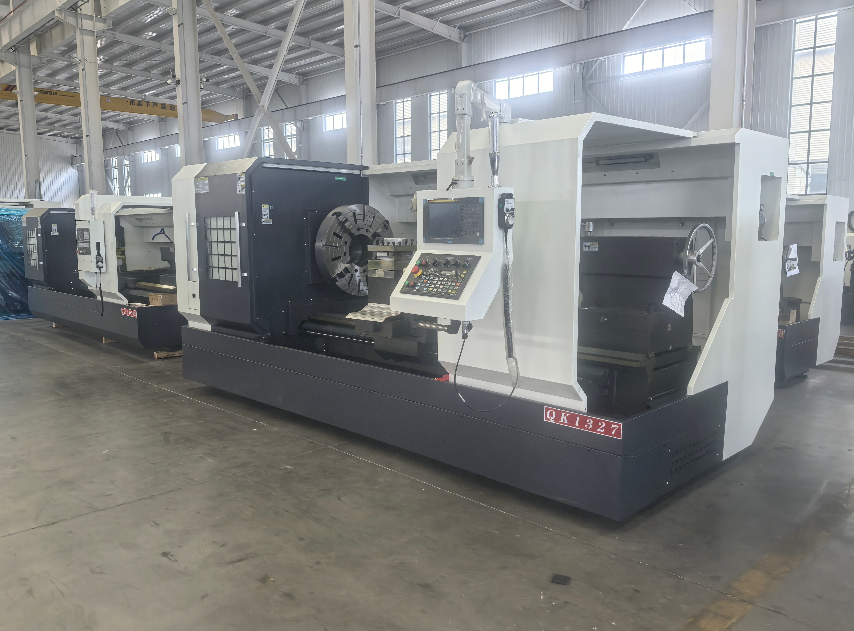
Precision Engineering Foundations of the CNC Pipe Threading Lathe Machine
Rigid bed construction and vibration-damping systems for dimensional stability
A heavy cast iron base sits at the heart of this machine, providing rock solid support for creating accurate threads while soaking up all those annoying vibrations from operation. The design incorporates special polymer concrete mixtures along with carefully placed mass dampers that work together to kill off unwanted harmonics when cutting at speed. What does this mean? Thread profiles stay remarkably consistent, typically staying within just 5 microns of their intended measurements even after hours of constant work. For industries where tight seals matter most like oil pipelines or chemical processing plants, maintaining these tiny tolerances makes all the difference between a reliable system and costly leaks down the road.
Thermal drift compensation and real-time mechanical deflection correction
Sensors placed on the axis drives and around the spindle housing send temperature readings to the CNC controller roughly every half second. When things get hot from all that friction, the machine makes tiny adjustments to the tool path to compensate for the expansion at microscopic levels. At the same time, there are load sensors keeping track of how much resistance the cutting process encounters. These sensors tell the servo motors when to tweak their torque output so tools don't bend out of shape. This helps maintain accurate thread forms even when working with tricky materials like pipes that have inconsistent walls or surfaces that aren't perfectly smooth throughout.
Advanced Motion Control and Thread-Specific G-Code Execution
Servo-driven axis synchronization with closed-loop feedback for pitch accuracy
Getting the rotational and linear axes perfectly aligned is absolutely essential when working on precision threading operations. Today's CNC pipe threading machines rely on servo driven systems paired with real time feedback loops. Encoders track both the spindle rotation and where the cutting tool actually is down to about 0.1 microns. Meanwhile, motion controllers crunch through position data roughly every two milliseconds. These specs allow the machine to adjust torque dynamically, keeping thread pitch accurate within plus or minus 0.005 mm per thread even when dealing with long sections of pipe. The system constantly checks for any deviations, making corrections as often as 500 times each second by comparing where the tool really is versus what was programmed. This rapid checking prevents small errors from building up and compromising the overall quality of the threaded connection.
Optimized thread cycles (G76, G92) and adaptive feed-rate modulation to eliminate chatter and taper
Specialized G codes such as G76 for multi pass threading and G92 for single point threading basically convert program instructions into actual thread shapes. With G76, the machine gradually decreases the cut depth during operation which helps control stress points and gives better surface quality. The G92 code makes tiny adjustments on the fly to compensate for tapers that naturally occur during machining. Modern CNC controllers can actually check the material's hardness and monitor tool wear while the part is being machined. They then adjust feed rates from one pass to the next to minimize unwanted vibrations. According to research published last year in the Journal of Manufacturing Processes, these kinds of smart adjustments cut down vibration levels by around 62 percent when compared to old school fixed parameter programming methods. This means manufacturers get consistent thread depths and proper flank angles even when dealing with parts that have varying wall thicknesses, all without needing someone to manually tweak settings halfway through production runs.
Metrological Validation Against Industry Thread Tolerance Standards
Mapping ANSI/ASME B1.20.1 (Classes 2B/3B) and ISO 965-1 (Class 6H) tolerances to CNC toolpath offsets and in-process verification
Modern CNC pipe threading lathes actually build measurement standards right into their machining processes. They map important specs from industry standards like ANSI/ASME B1.20.1 for unified threads and ISO 965-1 for metric threads, including common tolerance classes such as 2B, 3B, and 6H, into how they adjust tool paths during operation. What this means is that the machine constantly modifies things like how deep it cuts, how fast it feeds material through, and what kind of compensation it applies while working. There are also built-in probing systems that check the actual thread shape halfway through the job compared to what was programmed. If something goes off track even slightly beyond +/- 0.01 mm, these systems kick in automatically to fix things. Take a situation where the pitch diameter starts drifting toward the top limit of a 3B class specification. Instead of stopping everything for manual checks later on, the machine makes necessary adjustments during the same production cycle. This approach not only saves time but keeps around 99.8% compliance rates in those critical applications involving high pressure fluids.
| Tolerance Class | Application Scope | Critical Control Parameters |
|---|---|---|
| ASME 2B | General-purpose piping | Pitch diameter ±0.05mm |
| ASME 3B | High-pressure seals | Minor diameter taper ¥0.03mm/m |
| ISO 6H | Metric hydraulic systems | Thread flank angle ±0.5° |
This closed-loop validation ensures threads reliably withstand operational stresses exceeding 10,000 PSI—preventing leakage failures and eliminating costly rework through in-process quality assurance.
FAQ Section
What is the significance of rigid bed construction in CNC pipe threading machines?
The rigid bed construction, often made from heavy cast iron, provides essential support and stability, minimizing vibrations and ensuring consistent, accurate thread cutting.
How do CNC machines compensate for thermal drift and mechanical deflection?
CNC machines use sensors to monitor temperature and resistance changes. They make real-time adjustments to tool paths and servo motor torque to maintain thread accuracy despite thermal expansion and mechanical deflection.
What are G76 and G92 codes used for in CNC threading?
G76 and G92 codes are used for threading operations. G76 is for multi-pass threading that controls cut depth for better surface quality, while G92 handles single-pass threading with adjustments for natural tapers, enhancing accuracy and consistency.
Why are industry thread tolerance standards important in CNC machining?
Industry thread tolerance standards like ANSI/ASME B1.20.1 and ISO 965-1 guide CNC machines in maintaining precise measurements, ensuring high compliance and reliability, particularly for critical applications involving high-pressure fluids.