EN
EN

EDM Machine Fundamentals: Non-Contact, Thermoelectric Machining for Stress-Sensitive Parts
How electrical discharges and dielectric fluid enable controlled erosion without mechanical force
Electrical Discharge Machining, commonly known as EDM, works by creating controlled electrical sparks that literally vaporize conductive materials without any direct physical contact between tools. When there's a voltage difference between the electrode and the workpiece submerged in special dielectric fluid like deionized water or certain types of oil, the fluid gets ionized. This creates brief but extremely hot plasma channels reaching temperatures above 8,000 degrees Celsius. What happens next? The tiny electrical discharges gradually wear away material one particle at a time. Meanwhile, the same dielectric fluid does triple duty cooling down the area, sweeping away bits of debris, and restoring electrical insulation properties. For actual machining results, we're talking about material removal speeds ranging from 0.1 to 15 cubic millimeters per minute, with incredible dimensional accuracy holding tight within plus or minus 0.0002 inches (about 5 micrometers). The real magic here comes from how EDM doesn't care about material hardness at all. It can tackle tough stuff like tungsten carbide or super hard tool steels rated over 60 HRC just as easily as softer metals like aluminum something traditional cutting methods simply cannot match.
Eliminating workpiece distortion, microcracking, and residual stress in hardened or thin-walled alloys
When there's no mechanical contact involved, it gets rid of those sideways forces we often see in regular machining setups where they can go over 500 Newtons. These forces tend to warp really thin walls below half a millimeter thick or start tiny cracks forming in tough alloys. Milling operations typically cause deformation ranging from about 0.002 to 0.010 inches (roughly 50 to 250 micrometers) on delicate parts. But with EDM technology, dimensional stability stays within just 0.0001 inches (around 2.5 micrometers). The quick cooling effect of dielectric fluids keeps the area affected by heat down to less than 0.001 inches (about 25 micrometers), compared to as much as 0.020 inches (or 500 micrometers) when using traditional milling methods. This makes all the difference for things like aerospace turbine blades where thermal stress fractures could spell disaster. Because of this advantage, manufacturers can machine Inconel 718 directly after heat treatment without worrying about residual stresses messing up the material's ability to withstand repeated loads. And let's not forget about medical implants either, where having absolutely no defects matters greatly for both safety and how well they work inside the body over time.
Precision Capabilities of EDM Machines: Micron Tolerances and Geometry Freedom
Consistent ±0.0002 in (5 µm) accuracy and mirror-like finishes on conductive metals
EDM can achieve consistent dimensional accuracy around ±0.0002 inches or about 5 microns throughout production batches thanks to its non-contact, force free thermoelectric process. Since there's no tool deflection or chatter involved, this level of precision holds up even when working with parts that have already gone through heat treatment processes. Regular machining often causes dimensional changes from thermal stress, but EDM avoids those issues completely. The surface finish produced is almost mirror like, typically ranging between Ra 0.2 to 0.8 microns on materials like hardened steel and titanium as well as other conductive metals. This usually means manufacturers don't need to do any extra polishing work afterwards. For industries like aerospace making turbine blades that demand precise aerodynamic clearances, or medical device manufacturing where smooth surfaces prevent bacteria buildup and promote better tissue integration, these EDM capabilities make all the difference in product quality and performance.
Machining sharp internal corners, undercuts, and fragile features impossible with conventional tools
EDM can handle shapes that regular cutting tools just cant reach. Think about those tiny internal corners with radii smaller than 0.001 inches, deep undercuts, and those super thin walls (less than 0.004 inch thick) in tough alloys, all while avoiding any distortion or breaking of tools. Milling tools tend to bend or snap when they hit complex features, but EDM works differently. Its those controlled sparks through dielectric fluid that wear away material exactly where needed, pretty reliably too. Manufacturers regularly use this method for things like fuel injector nozzles with incredibly small holes, molds with tricky negative draft angles, and even those microscopic fluid channels in MEMS devices. And there's another benefit nobody talks about much these days: the ability to upgrade old parts. Companies can add new mounting points or fix worn areas without worrying about vibrations damaging them or heat messing up the integrity of the metal.
Selecting the Right EDM Machine Type for Your Complexity Tier
Choosing the optimal EDM process depends on your componentâs geometry, material condition, and production needs. Three primary types address distinct challenges:
- Sinker EDM excels at producing complex 3D cavitiesâsuch as injection mold cores, forging dies, or deep pocketsâwith true form fidelity. It uses a custom-shaped electrode plunged into the workpiece, ideal for features unreachable by rotating tools.
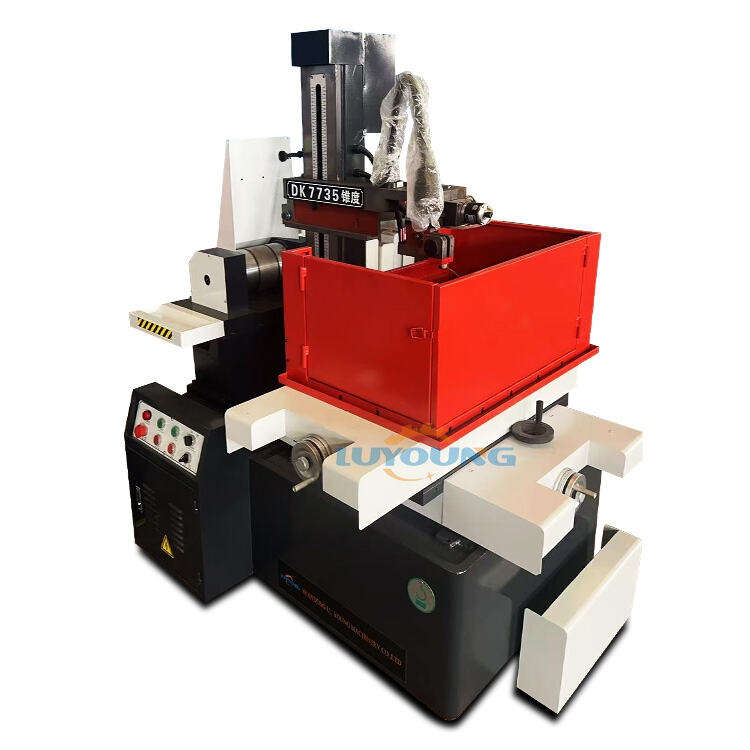
- Wire EDM employs a continuously fed, electrically charged brass or zinc-coated wire to cut precise 2D and tapered 3D contours. It delivers tight-tolerance through-cuts (±0.0002"), sharp external corners, and minimal kerf widthâmaking it optimal for turbine blades, precision gears, and delicate thin-section parts.
- Hole Drilling EDM rapidly produces small-diameter, high-aspect-ratio holes (e.g., Ã0.004"âÃ0.25") in fully hardened superalloysâcritical for starter holes in wire EDM operations or cooling channels in jet engine components.
Select sinker EDM for deep, sculpted cavities; wire EDM for high-accuracy through-cuts and fine external features; and hole drilling EDM for efficient, burr-free perforations in hardened materials. Final selection should also weigh material conductivity, feature depth-to-width ratios, and tolerance requirementsâespecially when targeting ±5 µm repeatability.
Real-World Applications: Where EDM Machines Solve Critical Manufacturing Challenges
Aerospace turbine blades, medical implants, and micro-mold tooling requiring zero-defect integrity
EDM stands out as the go-to manufacturing approach when there's absolutely no room for error. Take aerospace applications for instance, where EDM machines those complex turbine blades made from tough nickel-based superalloys. The process creates incredibly thin cooling channels, sometimes even thinner than a single strand of human hair, all while maintaining critical grain structures that affect how well these components resist fatigue over time. Medical device makers also turn to EDM technology for crafting titanium hip replacements and spinal implants. These parts need surface finishes under Ra 0.1 microns to reduce biofilm buildup and pass strict FDA tests regarding biocompatibility. When it comes to making molds for tiny devices known as MEMS (micro-electromechanical systems), EDM delivers injection cavity details within about 2 microns accuracy. That kind of precision goes way beyond what traditional milling methods can achieve. And let's not forget the big advantage here: since EDM doesn't actually touch the material during processing, it avoids creating those pesky subsurface cracks that plague brittle or heat sensitive materials. This makes EDM indispensable for industries where defects simply won't be tolerated in highly regulated environments.
Retrofitting legacy parts and machining post-heat-treated components without rework
Electrical Discharge Machining (EDM) stands out when it comes to modifying hardened or old components while keeping their metal properties intact. The process can restore worn gear teeth on 60 HRC tool steels without needing to go through annealing procedures, which means maintaining all the important qualities like hardness, resistance to wear, and stable dimensions. For those tricky legacy aerospace systems, wire EDM lets engineers attach new mounting points or alignment features right onto valuable alloy parts that would otherwise be impossible to replace. Take carburized 62 HRC bearings for instance, EDM creates really precise slots within about 0.005 mm tolerance without causing any stress cracks or dimensional issues. Many manufacturers have seen their costs drop by around 40% compared to traditional rework approaches. This savings comes from cutting out heat treatment steps, generating less waste material, and getting things done faster overall.
FAQ
What is Electrical Discharge Machining (EDM)?
EDM is a non-contact, thermoelectric machining process that uses electrical discharges to erode conductive materials without physical contact between tools.
How does EDM differ from traditional machining?
Unlike traditional machining, EDM doesn't rely on mechanical force, which eliminates workpiece distortion and microcracking, particularly in hardened or thin-walled materials.
What are the types of EDM machines?
The primary types of EDM machines include Sinker EDM, Wire EDM, and Hole Drilling EDM, each suited for specific machining applications.
What industries benefit most from EDM?
Industries such as aerospace, medical device manufacturing, and micro-mold tooling benefit significantly due to EDM's precision and ability to maintain material integrity.
Table of Contents
- EDM Machine Fundamentals: Non-Contact, Thermoelectric Machining for Stress-Sensitive Parts
- Precision Capabilities of EDM Machines: Micron Tolerances and Geometry Freedom
- Selecting the Right EDM Machine Type for Your Complexity Tier
- Real-World Applications: Where EDM Machines Solve Critical Manufacturing Challenges
- FAQ