EN
EN

Structural Advantages of the Slant Bed CNC Lathe Machine for Precision Stability
Gravity-Aligned Cutting Force Distribution and Reduced Deflection
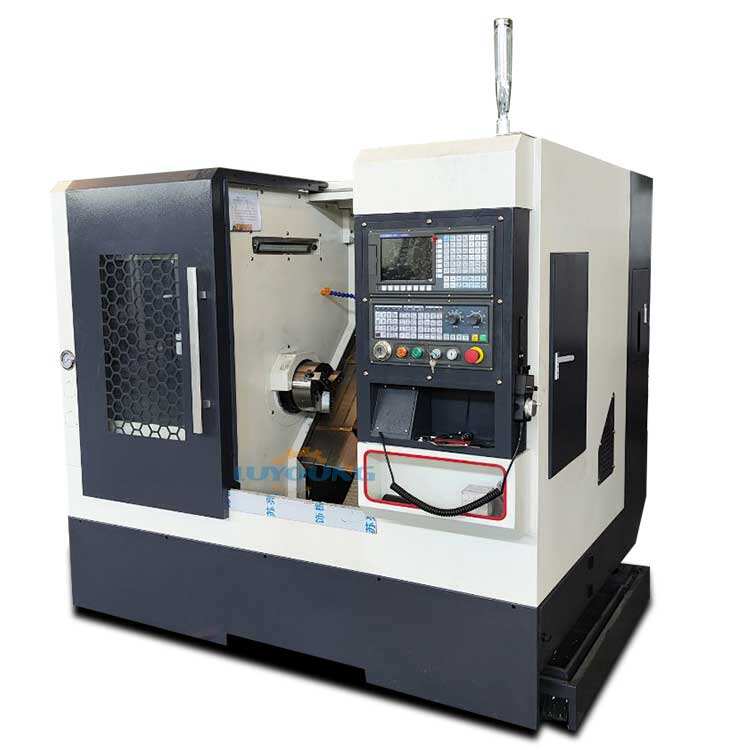
When looking at slant bed CNC lathes, their angled design actually works with gravity rather than against it. The cutting forces get directed straight down through the machine's structure, which means there's far less bending or warping when things get heavy duty. Compared to traditional flatbed models, this setup cuts down wear and tear on those important parts by around 40%. What does that mean practically? Machines can maintain really tight tolerances even when pushing hard. We're talking about staying accurate within just 0.002mm when dealing with loads over 8kN. And don't worry about speed either. These machines handle spindle rotations past 4,500 RPM without much shaking, so surfaces stay smooth and dimensions hold up. For industries where every micrometer counts, like making airplane parts or surgical instruments, this kind of stability makes all the difference between good enough and absolutely perfect.
Enhanced Rigidity from Integrated Cast-Iron Slant Bed Design
Cast iron slant beds with triangular cross sections offer significantly better structural rigidity compared to traditional bolted flatbed designs, typically increasing strength by around 15 to 25 percent. The absence of joints and fasteners in this single piece construction eliminates common failure points, spreading out torsion and cutting forces across the entire structure while standing up better to heat changes. With a lower center of gravity, these machines stay stable even when making aggressive cuts through tough materials. Plus, cast iron naturally dampens vibrations, so less shaking gets transmitted throughout the machine. All these features together mean operators can take deeper cuts without losing accuracy, which is exactly what manufacturers need for their high volume production runs where speed matters just as much as getting every dimension right.
Vibration Damping and Dynamic Rigidity in High-Volume CNC Turning
Linear Guideways, Preloaded Ball Screws, and Modal Stiffness Optimization
When dealing with high volume turning operations, machines need to stand up against all sorts of vibrations and positional shifts. That's where slant bed CNC lathes really shine thanks to their carefully designed motion systems. The linear guideways provide smooth movement with minimal friction, which helps cut down on those annoying harmonic vibrations when parts move quickly across the work area. Ball screws that have been preloaded take care of backlash issues, so we're talking about repeatable measurements down to around 5 microns even when working with heavy loads. Manufacturers use something called finite element analysis to tweak the machine's stiffness characteristics, basically shifting its natural frequencies out of the operating range to avoid that pesky resonant chatter that ruins surface finishes. Throw in some polymer composite damping materials that soak up roughly two thirds of the vibration energy, and suddenly we've got ourselves a rock solid platform for production. What does this mean in practice? Parts stay accurate within about plus or minus 0.005 mm throughout long production runs of 10,000 pieces, and tools last significantly longer too—around 30% longer than what we see on traditional machines.
Efficient Chip Evacuation and Thermal Management for Sustained Accuracy
Slant Bed Geometry Enables Gravity-Assisted Chip Flow and Coolant Drainage
Slant beds are typically set at angles ranging from around 30 to 60 degrees, which helps gravity pull chips away from where the actual cutting happens. When chips stay in the cutting area too long, they get cut again, causing all sorts of problems for tools and creating those annoying surface flaws nobody wants to see. The angle directs most of this mess straight into the collection bins instead. Coolant works better along these slopes too since it doesn't just sit around collecting heat like it does on flat surfaces. Compared to traditional flatbed models, slant designs keep space clear around what's being worked on without needing constant blasts from air guns. Shops report using roughly a quarter less cutting fluid when running continuously, which makes sense given how much cleaner everything stays during operation.
Reduced Heat Accumulation and Improved Thermal Stability Over Long Runs
When chips get removed continuously during machining, it helps keep temperatures down in the cutting area, which reduces thermal stress on everything from the spindle to the actual workpiece being machined. Studies show that slant bed machines tend to stay cooler overall, with about 40% fewer temperature swings over an 8 hour shift compared to older machine designs. Why does this happen? Well, there are several reasons working together here. First off, the cast iron frame spreads heat out more evenly. Then there's the coolant system that targets exactly where it needs to go at the point where tool meets material. And finally, when chips aren't getting recut into the workpiece, there's just less friction happening. All these things combined mean parts stay dimensionally accurate even after long periods of intense machining, typically staying within plus or minus 0.005 mm specifications.
Real-World Validation: Performance Consistency in High-Volume Production Environments
When it comes to tough manufacturing settings like auto part making, slant bed CNC lathes keep parts within about 0.005 mm tolerance even after running all day long. These machines combine solid construction with chips falling out naturally due to gravity plus better heat control throughout operation. This setup stops things from bending or shifting because of heat changes, which cuts down on waste materials by roughly 25-30% when compared against traditional flat bed alternatives. The stable performance means factories can crank out more products while still hitting quality standards, so many shops turn to slant beds for those non-stop production lines where getting consistent results matters most.
FAQ
Why is the angled design of slant bed CNC lathes beneficial?
The angled design helps align cutting forces with gravity, reducing bending or warping and enabling machines to maintain tight tolerances.
How does the cast-iron slant bed design enhance machine rigidity?
The single-piece construction of cast-iron slant beds offers better structural rigidity, dampens vibrations, and stands up better to heat changes.
What measures do slant bed CNC lathes have to handle vibrations?
They use linear guideways, preloaded ball screws, composite damping materials, and modal stiffness optimization to minimize vibration issues.
How do slant bed designs improve chip evacuation?
The angled geometry facilitates gravity-assisted chip flow, preventing chips from recutting, and directs them straight into collection bins, keeping the work area clean.
Table of Contents
- Structural Advantages of the Slant Bed CNC Lathe Machine for Precision Stability
- Vibration Damping and Dynamic Rigidity in High-Volume CNC Turning
- Efficient Chip Evacuation and Thermal Management for Sustained Accuracy
- Real-World Validation: Performance Consistency in High-Volume Production Environments
- FAQ