EN
EN

Superior Chip Evacuation and Surface Finish Stability
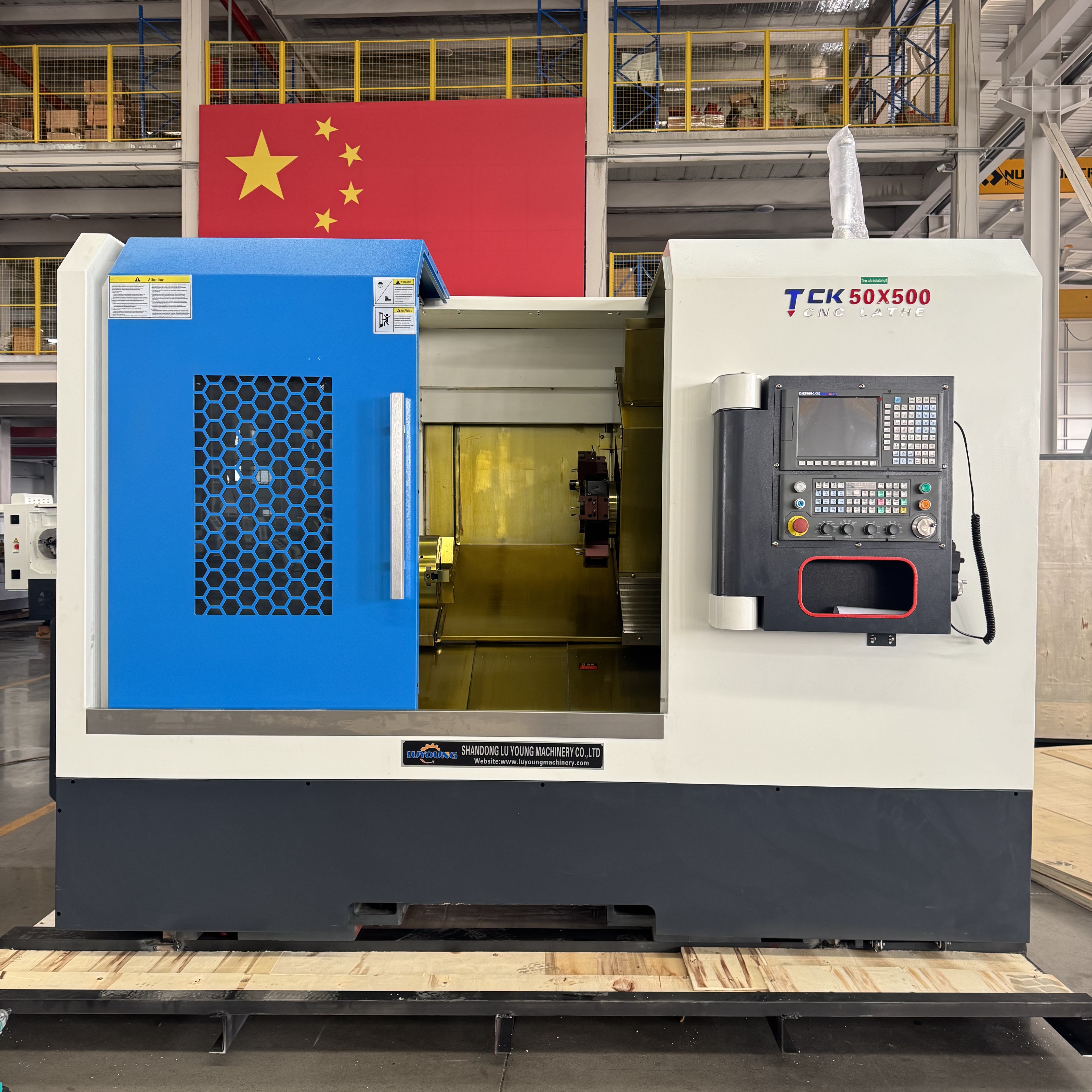
Gravity-Assisted Chip Flow from 30°–45°Slant Bed Geometry
Slant beds angled between 30 and 45 degrees work with gravity to push metal chips away from where the cutting happens and into special collection spots instead of letting them pile up right at the tool and workpiece meeting point. This kind of automatic chip removal works all the time without needing anyone to intervene. It keeps things cooler during operation since there's less heat building up, helps keep the coolant cleaner for longer periods, and means operators don't have to stop what they're doing so often just to clear out chips manually something that really eats into productivity on those flat bed machines where chips tend to collect everywhere.
40–60% Reduction in Chip Recutting Incidents Enhances Process Reliability
Slant bed machine designs help remove chips faster from the work area, which cuts down on those annoying chip recutting problems by somewhere around 40 to maybe even 60 percent. When there are fewer chips getting recut during machining, surfaces stay cleaner with less scratching damage happening. Tools last longer too since they don't get worn out as quickly from constant contact with metal shavings. And let's face it, nobody wants to stop production for unexpected tool changes when things could be running smoothly otherwise. Most experienced machinists notice these improvements show up in their daily operations. They see better uptime between maintenance stops and much more consistent results from one production batch to the next. This matters a lot during long production cycles where small changes over time can really impact how many good parts actually make it through quality control at the end of the day.
Direct Link to Consistent Sub-0.4 µm Surface Finish (Ra) in Finishing Passes
When chips flow continuously through the machine, they don't get redeposited on the workpiece during those final finishing passes. This helps cut down on those tiny scratches and material sticking to surfaces that can really mess up the finish quality. Slant bed CNC lathes typically produce finishes around 0.4 microns Ra or better. The machines stay stable enough to maintain very tight dimensional control, within about plus or minus 0.001 millimeters. Because of this reliability, these lathes have become go-to equipment for jobs requiring extreme precision like parts for airplanes, surgical instruments, and optical components where even the smallest deviation matters.
Enhanced Structural Rigidity for Vibration-Free Precision Machining
Monoblock Slant Bed Casting Delivers 35% Higher Torsional Stiffness vs. Flat Beds
Most slant bed CNC lathes feature what's called a monoblock casting, where the machine combines the bed, headstock, and tailstock all into one solid piece. This is different from those older models with bolted together flat beds. When parts are joined instead of cast as one unit, they tend to vibrate more during operation. Manufacturers claim these integrated designs offer around 35% better resistance to twisting forces. What does this mean for actual machining? Less bending when cutting through tough materials. The machine stays truer to its programmed path, so operators get consistently accurate results down to the micron level even when removing material quickly.
Sub-0.8 µm Tool-Tip Displacement Under High Dynamic Loads (8 g)
Under dynamic loads up to 8g—common during rapid acceleration, deceleration, or contouring—slant bed lathes limit tool-tip displacement to under 0.8 µm. This exceptional stability arises from three interlocking rigidity features: optimized mass distribution aligned with the 30°–45° slant axis, reinforced triangulated slideways, and high-damping cast iron alloys.
| Structural Feature | Vibration Impact | Precision Outcome |
|---|---|---|
| Monoblock casting | 35% lower harmonic resonance | ±1 µm dimensional hold over 8-hour runs |
| Low-center gravity | 50% faster vibration decay | Sub-0.8 µm tool deflection at 8g acceleration |
| Triangulated slideways | 40% reduced chatter amplitude | Consistent surface finishes below Ra 0.4 µm |
This structural integrity enables sub-micron positioning accuracy during high-speed contouring—making slant bed lathes indispensable for mission-critical components in aerospace and medical manufacturing.
Thermal Stability and Sustained Accuracy in Long Production Runs
Minimal Thermal Gradient (≤2.3°C) Across Bed During 8-Hour Continuous Operation
Heat distortion continues to be a major cause of part drift during long machining runs. The slant bed design of modern CNC lathes helps combat this issue through their symmetrical monoblock construction and built-in thermal control systems. These machines typically maintain temperature gradients below 2.3 degrees Celsius across the entire bed after running continuously for eight hours straight. By keeping temperatures stable throughout extended operations, these lathes protect essential components such as ball screws and linear guides from warping effects. This stability ensures parts stay within tight tolerances consistently, even when no one is watching the machine. In shops that run large batches of precision components, this means significantly reduced scrap rates and better overall production efficiency from the very first piece made.
Micron-Level Accuracy Enabled by Advanced Spindle and Motion Control
Active-Cooled Spindle with ≤1.5 µm TIR at 4,000 rpm Ensures Dimensional Repeatability
When we run temperature controlled fluid through the spindle housing, active cooling keeps thermal expansion down to around 1.5 microns TIR even when spinning at 4,000 rpm. This kind of thermal management stops the spindle from growing and causing dimensional issues while keeping tools engaged properly throughout extended machining cycles. Real world testing indicates that active cooled spindles can boost dimensional consistency by roughly 60 percent compared to regular air cooled versions, especially important during those intense machining operations. The difference matters a lot for parts where precision counts, like turbine blades or medical implants. If measurements go over 2 microns off spec, these components might fail in service or get rejected during quality checks, which nobody wants.
FAQ
What are the benefits of a slant bed geometry in CNC lathes?
Slant bed geometry helps in superior chip evacuation and surface finish stability by leveraging gravity to remove metal chips, which improves machining efficiency and enhances the tool life.
How does slant bed construction impact machine rigidity?
Slant bed machines provide enhanced structural rigidity, reducing vibration and improving machining precision due to features like monoblock casting, low-center gravity design, and triangulated slideways.
Why is temperature control important in CNC lathes?
Temperature control prevents thermal distortion, ensuring consistent accuracy and part tolerance during long production runs. Features like active-cooled spindles help maintain optimal performance.