EN
EN

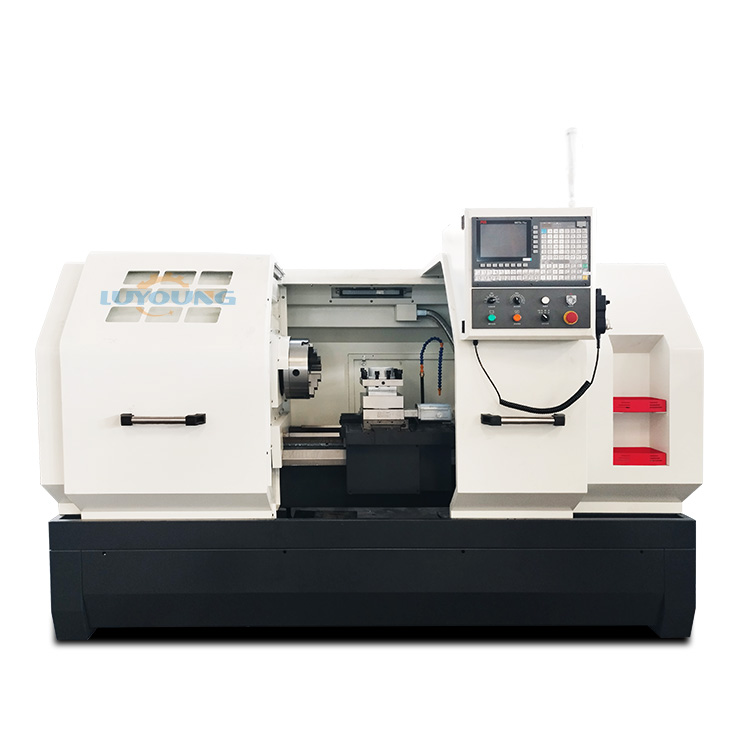
Heavy-Duty Machining: Core Strength of Flat Bed CNC Lathe Machines
Structural Advantages of Flat Bed Design for Rigidity and Stability
Flat bed CNC lathes with their horizontal design and solid cast iron build really stand up to vibrations during those intense cutting jobs. The machine's guideways are precision machined too, giving it about 30 percent better stability than what you get with welded steel options out there on the market. These machines keep tolerances tight around plus or minus 0.005 mm which matters a lot when working with aerospace grade aluminum parts. All this structural stiffness helps cut down on harmonic issues so manufacturers can maintain good quality control even when running thousands of automotive engine blocks through the production line day after day.
High-Torque Turning for Large Shafts in Power Generation
Equipped with direct-drive spindles delivering over 550 Nm of torque, these lathes efficiently machine turbine shafts up to 1.5 meters long. The flat bed design prevents deflection during interrupted cuts on tough materials like nickel-based superalloys used in hydroelectric generators, preserving tool life and dimensional accuracy.
Thermal Stability and Performance in Long-Duration Oil & Gas Applications
Temperature-compensated ballscrews limit thermal expansion to just 0.002 mm per hour during extended machining cycles, such as those required for API 6A wellhead flanges and valve bodies. This advanced thermal management reduces scrap rates by 18% compared to conventional lathes, improving yield and process reliability in oil and gas manufacturing.
Optimizing Cutting Parameters for Maximum Material Removal Rates
Adaptive toolpath programming increases roughing efficiency by 25% for ductile iron pump housings while maintaining a surface finish of Ra 3.2 µm. Integrated real-time load monitoring protects cutting inserts during heavy stainless steel turning, extending tool life by up to 40% without compromising performance.
Key Industrial Applications in Automotive, Aerospace, and Rail/Marine Sectors
Flat bed CNC lathe machines are essential for producing high-precision, durable components across mission-critical industries.
High-Volume Production of Automotive Components with Dimensional Accuracy
Automotive manufacturers use flat bed CNC lathes to produce engine shafts, transmission gears, and brake rotors at volumes exceeding 10,000 units monthly. Their rigid structure sustains ±0.005 mm tolerances under continuous operation, reducing post-machining rework by 18% compared to manual lathes (Parker Hannifin 2023). This consistency supports compliance with stringent industry quality benchmarks.
Precision Machining of Aerospace Turbine Shafts and High-Strength Alloys
The aerospace industry relies on these machines to create critical parts like titanium turbine shafts and Inconel components with incredibly smooth surfaces down to around Ra 0.8 microns. These machines typically run anywhere from 650 to 1200 revolutions per minute and keep their positioning accurate within just 5 microns. That kind of precision isn't optional when dealing with FAA certified aircraft parts. Some recent testing back in 2023 showed interesting results too. Components made from aerospace grade aluminum on flat bed machining systems actually lasted about 12 percent longer under stress compared to similar parts produced on slant bed lathes. Makes sense really, since the flat bed design offers better stability during the cutting process.
Railway Axles, Wheel Sets, and Marine Propeller Shafts on One Platform
Flat bed CNC lathes are essential tools for rail and marine engineers who need to produce heavy duty parts like 2 ton railway axles and 3 meter propeller shafts. The machines maintain concentricity down to just 0.02 mm thanks to their stable thermal properties. This matters a lot when making cuts through hardened steel wheels where even small vibrations can throw off the entire operation. What makes these setups so valuable is their versatility too. They handle 600 series aluminum components for marine applications at speeds around 30 percent faster compared to older techniques. For manufacturers working across different transportation sectors, this kind of performance boost really adds up over time and helps keep production lines running smoothly despite tight deadlines.
Material and Geometric Versatility of Flat Bed CNC Lathe Machines
Flat bed CNC lathes handle both ferrous (steel, cast iron) and non-ferrous metals (aluminum, brass) with micron-level precision, achieving surface finishes down to Ra 0.8 µm. The stable platform is ideal for asymmetric geometries such as eccentric shafts and irregular flanges, where balance and accuracy are paramount.
The modular tooling system can handle as many as twelve different stations at once, which means operators can drill, thread, and groove all within the same setup. The newer bed designs cut down on vibrations by around twenty-seven percent when compared with previous versions according to recent data from the 2023 machine tool usage report. What this does is let machinists switch between various materials without having to stop and recalibrate everything. Think about going from really tough hardened steel rated at HRC 60 straight into softer aluminum alloys that measure only HRC 15. Because they're so adaptable, these flat bed lathes work particularly well in manufacturing settings where there are lots of different parts made in small batches. Medical device manufacturers love them for creating intricate implant components, while companies making specialized industrial equipment also find them invaluable for their flexibility across diverse material requirements.
Cost-Effectiveness and Operational Accessibility in B2B Manufacturing
Flat bed CNC lathe machines offer a compelling balance of performance, affordability, and ease of maintenance—particularly suited for mid-sized manufacturers.
Affordability Compared to Slant Bed CNC Lathes in Mid-Range Workshops
Mid-range workshops benefit from a 15–20% lower initial investment compared to slant bed models, thanks to the simpler, linear construction of flat bed machines. Despite the reduced cost, they maintain ±0.005 mm accuracy, making them ideal for general engineering and automotive applications.
Lower Maintenance Needs Due to Simplified Mechanical Structure
The flat bed's linear configuration reduces lubrication points by 40%, lowering annual maintenance costs by $7,200 per machine (2023 industrial maintenance analyses). Efficient chip evacuation further enhances uptime, contributing to 92% operational availability in continuous production settings.
Balancing Performance and Investment: The Value Proposition of Flat Bed CNC Lathe Machines
These machines achieve 98% dimensional accuracy in steel machining while operating at 25% lower hourly costs than more complex alternatives. According to the 2024 Machine Tool Economics Report, mid-sized manufacturers typically recover their investment within 18 months through savings in energy consumption (averaging 1.2 kWh per cycle) and reduced tooling expenses.
Frequently Asked Questions (FAQ)
What is the main advantage of using flat bed CNC lathe machines?
Flat bed CNC lathe machines offer superior structural stability and rigidity, which reduce vibrations during machining, leading to precise cuts and better quality control.
How do flat bed designs benefit power generation applications?
Flat bed designs prevent deflection during interrupted cuts on tough materials like superalloys, preserving tool life and ensuring dimensional accuracy.
What kinds of metals can flat bed CNC lathes handle?
These lathes can handle both ferrous metals like steel and cast iron, and non-ferrous metals like aluminum and brass, with high precision.
Are flat bed CNC lathes cost-effective for mid-sized manufacturers?
Yes, they offer a balance of performance, affordability, and ease of maintenance, making them particularly suitable for mid-sized manufacturing operations.
Table of Contents
- Heavy-Duty Machining: Core Strength of Flat Bed CNC Lathe Machines
- Key Industrial Applications in Automotive, Aerospace, and Rail/Marine Sectors
- Material and Geometric Versatility of Flat Bed CNC Lathe Machines
- Cost-Effectiveness and Operational Accessibility in B2B Manufacturing
- Frequently Asked Questions (FAQ)