EN
EN

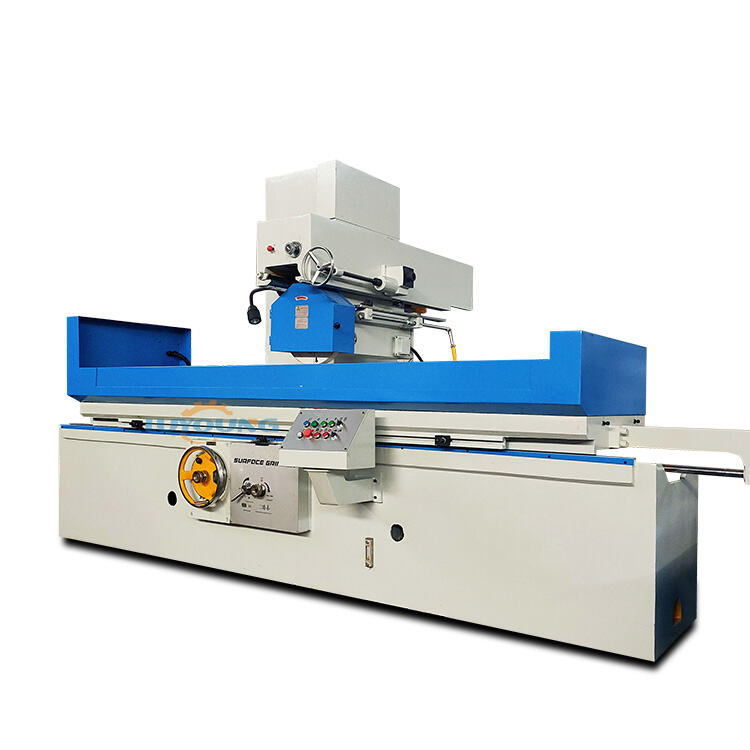
Surface Grinding Machines: Delivering Ultra-Fine Flatness (Ra 0.4–0.08 μm)
How Horizontal-Spindle Design Enables Sub-Micron Flatness and Thermal Stability
The HSG surface grinders can reach those impressive Ra 0.08 micrometer finishes thanks to their solid build quality combined with careful temperature control systems. What makes these machines stand out is their low center gravity setup which basically stops vibrations from messing up the grind at high speeds something that vertical spindle models just cant match. The cool thing about these grinders? They have those built in coolant jackets wrapped around the spindle area keeping temperatures stable within half a degree Celsius. This really matters when working with tricky materials like Inconel that melt easily under heat. Some studies published last year showed that this kind of thermal management cuts down on expansion issues by around 80 percent. That means manufacturers get consistently flat surfaces even on big parts that tend to warp when heated, like those long machine tool guideways we all deal with in production shops.
Critical Process Factors: Wheel Selection, Coolant Precision, and CNC Feed Control
Ultra-fine surface integrity hinges on tight coordination among three interdependent variables:
- Abrasive Wheel Composition: Cubic boron nitride (CBN) wheels with grit densities exceeding 800 deliver finer, more consistent cuts than conventional aluminum oxide alternatives
- High-Pressure Coolant Delivery: Targeted nozzles applying 1,500 PSI coolant prevent swarf adhesion, suppress thermal buildup, and eliminate workpiece burn
- Dynamic Feed Control: CNC systems modulating feed rates below 0.5 mm/second during final passes suppress chatter and preserve edge definition
Parameter synchronization is essential: aggressive feeds, for instance, negate the advantages of premium CBN wheels. Laser interferometry–based monitoring now detects deviations beyond 0.2 μm in real time, automatically adjusting feed rates during finish grinding to uphold Ra 0.08 μm consistency.
Cylindrical Grinding Machines: Consistent Roundness and Roughness (Ra 0.2–0.08 μm)
Pinch/Peel Geometry and Its Role in Minimizing Thermal Distortion
The pinch/peel grinding setup cuts down on heat production because it shortens how long the grinding wheel stays in contact with the workpiece. When we control this contact better, less thermal energy gets transferred into the component itself. That matters a lot for things like hydraulic shafts and those tiny aerospace bearings where even small distortions are problematic. These configurations also help keep parts rounder for longer periods since they limit the area affected by heat and let coolants reach deeper into the work zone. The results? Roundness stays within about 0.00005 inches (roughly 1.3 micrometers) and surfaces finish smooth enough at around Ra 0.1 micrometer level. If manufacturers skip these thermal controls though, simple uneven heating patterns across different sections of a part can actually cause dimensional changes greater than 5 micrometers over just one meter of component length during processing.
Real-Time Dressing Compensation and Sub-Micron Axis Synchronization
Today's cylindrical grinders come equipped with real time dressing systems that keep reshaping the grinding wheel as it works. These systems fight against the natural wear and loading that happens during extended production runs, so the cutting stays efficient for longer periods. At the same time, these machines use sub micron level synchronization between rotation and linear movement. This means they can maintain position accuracy down to about 0.1 microns even when working on complicated shapes and curves. The latest CNC control systems are constantly checking both the wheel position and what's being worked on, making hundreds of tiny adjustments every single second. This helps avoid those annoying surface flaws that show up in really fine finishes like Ra 0.08 microns. For manufacturers producing medical implants where precision matters most, this integrated approach not only boosts output but also cuts down on the time wasted waiting for someone to manually dress the wheels. Some shops report saving around 70% of that downtime, which adds up to serious productivity gains over time.
Centerless Grinding Machines: High-Volume Precision for Small Rotating Parts (Ra 0.4–0.2 μm)
Centerless grinding works differently from conventional methods since it doesn't need mechanical fixtures. Instead, it relies on a special support system where a regulating wheel spins cylindrical parts against another grinding wheel. These wheels can reach pretty impressive speeds around 4,500 to 6,000 feet per minute (about 23 to 30 meters per second). At these speeds, the machine can remove material at rates as high as one cubic inch every single second. What makes this process stand out is how consistently good the surface finish turns out, typically ranging from Ra 0.4 to 0.2 micrometers. Diameter tolerances are also remarkable tight within plus or minus 0.0001 inch. For manufacturers looking to produce lots of small rotating components such as bearing races or bushings, this level of consistency is exactly what they need. Another big advantage comes from continuous feed systems that basically get rid of those pesky centering errors while cutting down setup time by roughly 70% when compared to older chucking techniques. Most shops find this saves them both time and money in the long run.
Key operational advantages include minimal operator intervention via automated loading, thermal stability from optimized coolant delivery, roundness accuracy within 0.0002 inch for diameters under 3.5", and throughput exceeding 500 parts/hour in high-volume automotive applications.
| Performance Metric | Centerless Grinding Capability |
|---|---|
| Maximum Part Length | 12" |
| Surface Finish Range | Ra 0.4–0.2 μm |
| Diameter Tolerance | ±0.0001" |
| Production Volume Threshold | 1,000+ units |
The absence of clamping forces makes centerless grinding especially effective for slender or thin-walled components prone to deflection–achieving 40% faster cycle times than chuck-based methods while preserving geometric and surface integrity.
Internal Grinding Machines: Overcoming Rigidity Challenges for Bore Finishing (Ra 0.4–0.1 μm)
Spindle Stiffness, Tool Deflection, and Deep-Hole Stability Trade-Offs
Internal grinding runs into serious rigidity issues, especially when dealing with those deep bore applications. Spindle deflection combined with tool vibration really messes with surface finish quality. Once we get past that 8:1 depth-to-diameter ratio mark, getting down to Ra 0.1 microns requires some serious balancing act. High speed spindles spinning over 24k RPM definitely cut down on cutting forces but they bring their own headaches with harmonic distortion risks. On the flip side, those super rigid low RPM setups keep deflection at bay but end up generating way too much heat during those fine finishing passes. For aerospace work where finishes need to stay under Ra 0.2 microns, this balance is absolutely crucial. And when tolerances start tightening up past plus or minus 0.005 mm, shops often find themselves stuck adding honing operations as a second step. Machining efficiency reports show these extra steps can eat up anywhere from 30% to 50% more time in the overall production cycle.
Smart Monitoring: Acoustic Emission Sensors for Proactive Ra Control
Advanced internal grinders commonly feature acoustic emission (AE) sensors these days. These devices pick up on tiny vibrations between 100 to 500 kHz that indicate when grinding wheels start to dull or develop chatter problems long before the surface roughness goes beyond Ra 0.4 microns. When the system detects these vibrations, it automatically makes adjustments to slow down the feed rate by about 15 to 30 percent. This happens whenever there's a spike in AE amplitude that matches signs of subsurface material tearing during the grinding process. What we get as a result is consistently smooth bore finishes reaching Ra 0.1 microns without needing any hands-on operator adjustments. This level of precision matters a lot for parts like hydraulic components and fuel injectors, since even minor surface imperfections above 0.2 microns can lead to serious fluid leakage issues. Manufacturers working with fuel injectors have reported field results showing that using AE monitoring cuts down scrap rates by approximately 22% across their high precision internal grinding operations.
FAQ
What is the advantage of using HSG surface grinders?
HSG surface grinders achieve ultra-fine flatness through solid build quality and temperature control, minimizing vibrations and thermal expansion, leading to consistent finishes even on large parts.
How does pinch/peel grinding reduce thermal distortion?
Pinch/peel grinding shortens wheel contact time with the workpiece, reducing thermal transfer and distortion, which is crucial for maintaining roundness in parts like hydraulic shafts.
What makes centerless grinding suitable for high-volume production?
Centerless grinding provides high-speed material removal without mechanical fixtures, enabling tight tolerances and consistent surface finishes, ideal for producing small rotating parts efficiently.
Why are acoustic emission sensors important in internal grinding machines?
Acoustic emission sensors detect wheel dullness and chatter early, allowing automatic adjustments that ensure precise, smooth bore finishes necessary for components like hydraulic parts.
Table of Contents
- Surface Grinding Machines: Delivering Ultra-Fine Flatness (Ra 0.4–0.08 μm)
- Cylindrical Grinding Machines: Consistent Roundness and Roughness (Ra 0.2–0.08 μm)
- Centerless Grinding Machines: High-Volume Precision for Small Rotating Parts (Ra 0.4–0.2 μm)
- Internal Grinding Machines: Overcoming Rigidity Challenges for Bore Finishing (Ra 0.4–0.1 μm)
- FAQ